TL;DR
- Snow removal, plowing and clearing are often used interchangeably, but they describe different scopes of work with different pricing.
- A full residential service typically covers driveways, walkways and entrances, sometimes with de-icing bundled in and sometimes charged separately.
- Commercial contracts add parking lots, loading docks, emergency exit access and often faster response commitments.
- Pre-season staking and a documented property assessment matter more than most homeowners realise, since they prevent landscaping and driveway edge damage.
- Snow left on a roof or in a gutter connects directly to ice dam risk, which is why some snow-adjacent damage isn’t actually a snow removal problem at all.
What “Snow Removal” Actually Means
This is the point that trips up more homeowners than any pricing detail, and it’s worth clarifying before comparing any quotes. In everyday conversation, “snow removal” gets used as a catch-all term for anything involving clearing snow from a property. In an actual service contract, though, snow removal has a specific technical meaning, physically loading snow onto trucks and hauling it off the property entirely, distinct from plowing, which simply pushes snow aside on-site (Snow Management Service Descriptions, 2024). Snow blowing and shoveling are separate categories again, typically used for tighter areas where a plow blade isn’t practical, like narrow walkways or steps.
Understanding this distinction matters because two quotes that both say “snow removal” can describe genuinely different scopes of work, one might mean your driveway snow gets pushed to the side of your property, while the other means it gets physically hauled away. Neither is wrong, but they’re not interchangeable, and the price difference between them usually reflects that.
Snow Plowing vs Snow Removal vs Snow Clearing: A Clear Comparison

Rather than treating these as synonyms, it helps to see them laid out side by side.
| Term | What actually happens | Where the snow ends up | Typical use case |
| Snow plowing | Snow is pushed aside using a plow blade | Stays on the property, moved to an edge or corner | Driveways, larger paved areas |
| Snow removal | Snow is physically loaded and hauled away | Leaves the property entirely | Small lots with no space to pile snow, or after repeated storms |
| Snow clearing / blowing / shoveling | Manual or blower-based clearing in tighter spaces | Usually stays nearby, moved by hand or blower | Walkways, steps, tight areas a plow can’t reach |
| De-icing | Ice melt or salt applied to treated surfaces | N/A, this is a chemical treatment, not a clearing method | Driveways, walkways, stairs, entrances |
In practice, most residential contracts combine plowing for the driveway with hand shoveling or blowing for walkways and entry points, since a single plow truck usually can’t safely or effectively clear a narrow walkway or set of steps.
Pre-Season Preparation: What Happens Before It Snows
Professional snow removal genuinely starts before the first snowfall, not once winter arrives. This preparation stage includes staking, placing reflective markers along driveway edges, lawn boundaries and any landscaping features so crews know exactly where the property line and paved surfaces sit once everything is buried under snow (KG Landscape snow contract guidance, 2024). Skipping this step is one of the most common causes of accidental landscaping or driveway edge damage, since a plow operator working from memory or guesswork under snow cover has no reliable way to know where a lawn ends and a driveway begins.
A proper pre-season visit should also include documenting the existing condition of paved surfaces, since this protects both the homeowner and the provider if a dispute over pre-existing cracks or damage comes up later in the season.
What’s Typically Included in Residential Snow Removal
A standard residential contract generally covers a defined, agreed set of areas rather than “the whole property” as a vague catch-all.
- Driveway clearing, using a plow, blower or shovel depending on width and access
- Walkway and entrance path clearing, usually by hand or blower given the tighter space
- Steps and entry points, cleared carefully to reduce slip risk
- De-icing or ice melt application, sometimes included and sometimes billed as an add-on
- A trigger depth or storm threshold, meaning service begins automatically once snowfall reaches an agreed amount, rather than requiring the homeowner to call
That last point matters more than it might seem. A contract that clears at 2 inches of accumulation gives very different service than one that waits for 5 inches, and this detail is often buried in the fine print rather than stated clearly upfront.
What’s Typically Included in Commercial Snow Removal
Commercial contracts scale up in both scope and urgency, since a blocked parking lot or entrance has a direct impact on a business’s ability to operate.
- Parking lot plowing, often across multiple sections or zones
- Loading dock clearing, prioritised for delivery access
- Entrance and emergency exit clearing, treated as a safety priority
- Ongoing snow management throughout a storm, not just a single pass afterward
- Faster guaranteed response times, sometimes committing to service within a set number of hours of snowfall ending
Larger commercial properties often need snow physically hauled away rather than simply plowed to the side, since a parking lot has limited space to pile snow without losing usable parking spots, which is exactly where the plowing versus removal distinction becomes a real, practical decision rather than just terminology.
Ice Management and De-Icing: A Separate Service Often Bundled In
This is one of the more variable parts of a snow removal contract, and it’s worth asking about directly rather than assuming it’s automatically included. De-icing involves evaluating temperature and surface conditions, then applying the appropriate ice melt product to walkways, driveways, stairs and entrances to reduce slip hazards (HomeStars regional service guidance, 2024). Some providers bundle this into a flat seasonal price, while others charge per application or per visit, and this difference alone can meaningfully change the total cost of a season’s service.
It’s also worth asking what specific product a provider uses, since some ice melt products can damage certain paving materials, plant beds or pet paws, and a provider who can answer this clearly and confidently is generally a good sign of overall service quality.
How Snow Removal Pricing Structures Actually Work
Pricing in this industry varies more than most home services, since weather itself is unpredictable, and understanding the common structures helps you compare quotes on equal terms.
- Per push: charged each time a plow clears the property, tied directly to how many times it snows
- Per event: similar to per push, but tied to a defined “storm event” rather than each individual visit
- Per inch: pricing scales with how much snow actually falls, sometimes with a base rate plus an additional charge past a certain depth
- Seasonal contract: a flat rate covering the whole winter regardless of how much or how little it snows
Seasonal contracts offer the most predictable budgeting, since a heavy snow season doesn’t increase the cost, though a light season means less relative value. Per push or per inch pricing can work out cheaper in a mild winter but genuinely unpredictable in a heavy one, which is why understanding your own risk tolerance for winter budgeting matters as much as the quoted rate itself.
Response Times and Storm Communication
This is one of the most variable, and most important, parts of comparing providers, since two companies at a similar price point can offer completely different real-world experiences during an actual storm (KG Landscape service comparison guidance, 2024). Some providers commit to clearing within an hour of snowfall ending, others offer a much looser window, and some provide little to no proactive communication about timing at all. Asking directly what response time is guaranteed, and what happens during a major, multi-day storm specifically, is one of the most useful questions to ask before signing any contract.
What’s Typically Not Included
Most contracts include reasonable disclaimers worth understanding upfront rather than discovering after the fact. Surface damage to driveways, sidewalks or curbs from plow blades is generally not the provider’s responsibility, since some minor scraping risk comes with the process itself, particularly on older or already-damaged pavement. Damage to landscaping features not properly staked before the season, mailboxes, and other obstacles are similarly often excluded, especially if the homeowner didn’t flag their locations during the pre-season assessment. Extreme, unusually heavy storms may also trigger additional charges beyond the standard contract price, which is why most agreements include language allowing for adjusted pricing under unforeseen conditions.
Why Snow Removal Connects Directly to Your Roof and Eavestroughs
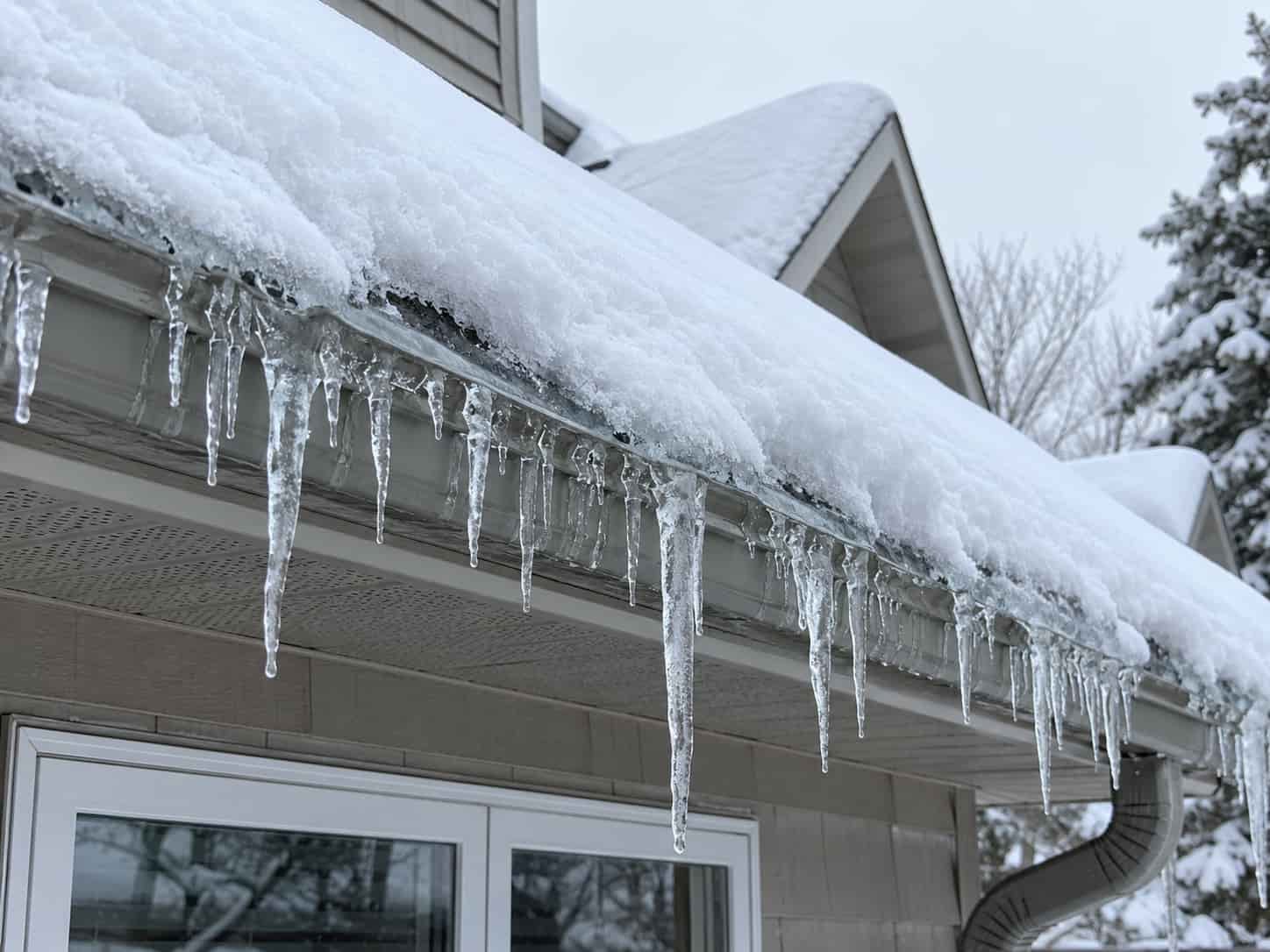
This is a connection most snow removal content never makes, even though it directly affects a property’s winter risk profile. Snow removal service typically covers ground-level surfaces, driveways, walkways and parking areas, but doesn’t address snow and ice accumulating on the roof itself or inside eavestroughs. If gutters are already clogged going into winter, snow melt has nowhere to properly drain, which is a leading contributor to ice dam formation along the roofline. Our earlier guide on what eavestrough cleaning actually involves covers this ice dam risk in more detail, and it’s worth treating ground-level snow removal and pre-winter gutter maintenance as two separate but connected parts of the same seasonal preparation, rather than assuming one covers the other.
How to Choose a Snow Removal Provider
A few direct questions during the quote process reveal more about service quality than the price alone ever will:
- What is your guaranteed response time once snowfall stops
- Is de-icing included, or billed separately per application
- What snowfall depth triggers automatic service
- Do you perform pre-season staking and a documented property assessment
- What happens during a major, multi-day storm event specifically
- Are you insured, and can you provide proof before the first service
A provider who answers these clearly and specifically, rather than vaguely, is generally the stronger choice regardless of which pricing structure they use.
Frequently Asked Questions
Is snow removal the same as snow plowing?
Not technically. Plowing pushes snow aside on the property, while removal means physically hauling snow away entirely. Many contracts use both terms loosely, so it’s worth confirming which is actually being provided.
Does snow removal include de-icing or salting?
Sometimes, but not always automatically. Many providers bundle ice melt application into a seasonal contract, while others charge for it separately per visit.
How much snowfall usually triggers a service visit?
This varies by contract, commonly somewhere between 1 and 3 inches, though some agreements wait for higher accumulation. This threshold should always be stated clearly in the contract.
What isn’t typically covered by a snow removal contract?
Surface damage to already-cracked pavement, unstaked landscaping features, and extreme storm conditions beyond normal scope are commonly excluded or subject to additional charges.
Why does pre-season staking matter?
Staking marks property boundaries and landscaping edges before snow cover makes them invisible, which significantly reduces the risk of accidental damage during plowing.
Does clearing my driveway also protect my roof from ice dams?
No, these are separate concerns. Ground-level snow removal doesn’t address roof or gutter drainage, which is why clean eavestroughs going into winter matter just as much as a cleared driveway.
Should I choose a seasonal contract or pay per visit?
This depends on your winter budgeting preference. Seasonal contracts offer predictable costs regardless of snowfall, while per-visit pricing can be cheaper in a mild winter but less predictable in a heavy one.