TL;DR
- The most serious mistake is unsafe ladder use. The Canadian Centre for Occupational Health and Safety (CCOHS) advises a 4:1 ladder angle and three-point contact at all times (CCOHS, 2023).
- Ignoring downspouts is the most common reason gutters still overflow after cleaning.
- Blowing debris into a downspout, or hosing out heavy clogs, makes blockages worse (Bob Vila, 2024).
- High-pressure washing, the wrong tools and leaning ladders on gutters can damage the system.
- Professional eavestrough cleaning typically costs $1.00 to $2.50 per linear foot in Ontario (HomeStars, 2026).
What Are the Most Common Gutter Cleaning Mistakes?
The most common mistakes are using an unsafe ladder, ignoring the downspouts, using the wrong tools, pressure washing too hard and cleaning too rarely. Each one either risks injury or leaves the gutter still unable to carry water, which is the whole point of cleaning.
| Mistake | What goes wrong | The fix |
|---|---|---|
| Unsafe ladder use | Falls and injuries | Proper ladder, correct angle, a helper |
| Ignoring downspouts | Overflow and backups | Flush and test every downspout |
| Wrong tools | Scratched, bent or blocked gutters | Plastic scoop, gloves, bucket |
| Pressure washing | Damaged seams and sealant | Low pressure, hand cleaning first |
| Hosing heavy clogs | Slurry and downspout blockage | Remove bulk debris first |
| Cleaning too rarely | Weight, rust, ice damage | Clean at least yearly, often twice |
Mistake 1: Is It Safe to Climb a Ladder for Gutter Cleaning?
Only if the ladder, angle and conditions are right. Unsafe ladder use is the biggest risk in gutter cleaning. Use a sturdy extension ladder on firm ground, set it at the right angle, keep three points of contact and have someone hold the base.
CCOHS says that for every 4 feet (1.2 metres) up, the base should sit 1 foot (0.3 metres) from the wall (CCOHS, 2023).
It also says to maintain three-point contact, with two hands and one foot or two feet and one hand on the ladder at all times. Keep ladders away from power wires, and use a fibreglass ladder if electricity is a hazard (CCOHS, 2023).
- Do not use a step ladder. Bob Vila notes step ladders can tip, so a sturdy extension or telescoping ladder is safer (Bob Vila, 2024)
- Use stabilizer arms and a helper to hold the base
- Never work in rain, wind or ice
- Do not overreach. Climb down and move the ladder
- Stay clear of power lines and service cables
Bob Vila adds that homes over one storey are better left to a gutter cleaning company, and that you should not walk on the roof (Bob Vila, 2024). That is sound advice for most two-storey homes in the Toronto area.
Can You Lean a Ladder Against the Gutter?
Avoid it. Gutters are not designed to carry a person’s weight, and a ladder resting on one can bend it or pull it away from the fascia. Use stabilizer arms that rest on the wall, so the load sits on the house and not the gutter.
The sources reviewed do not address this specifically, so treat it as general good practice and ask a professional if you are unsure.
Mistake 2: Why Is Ignoring the Downspouts a Problem?
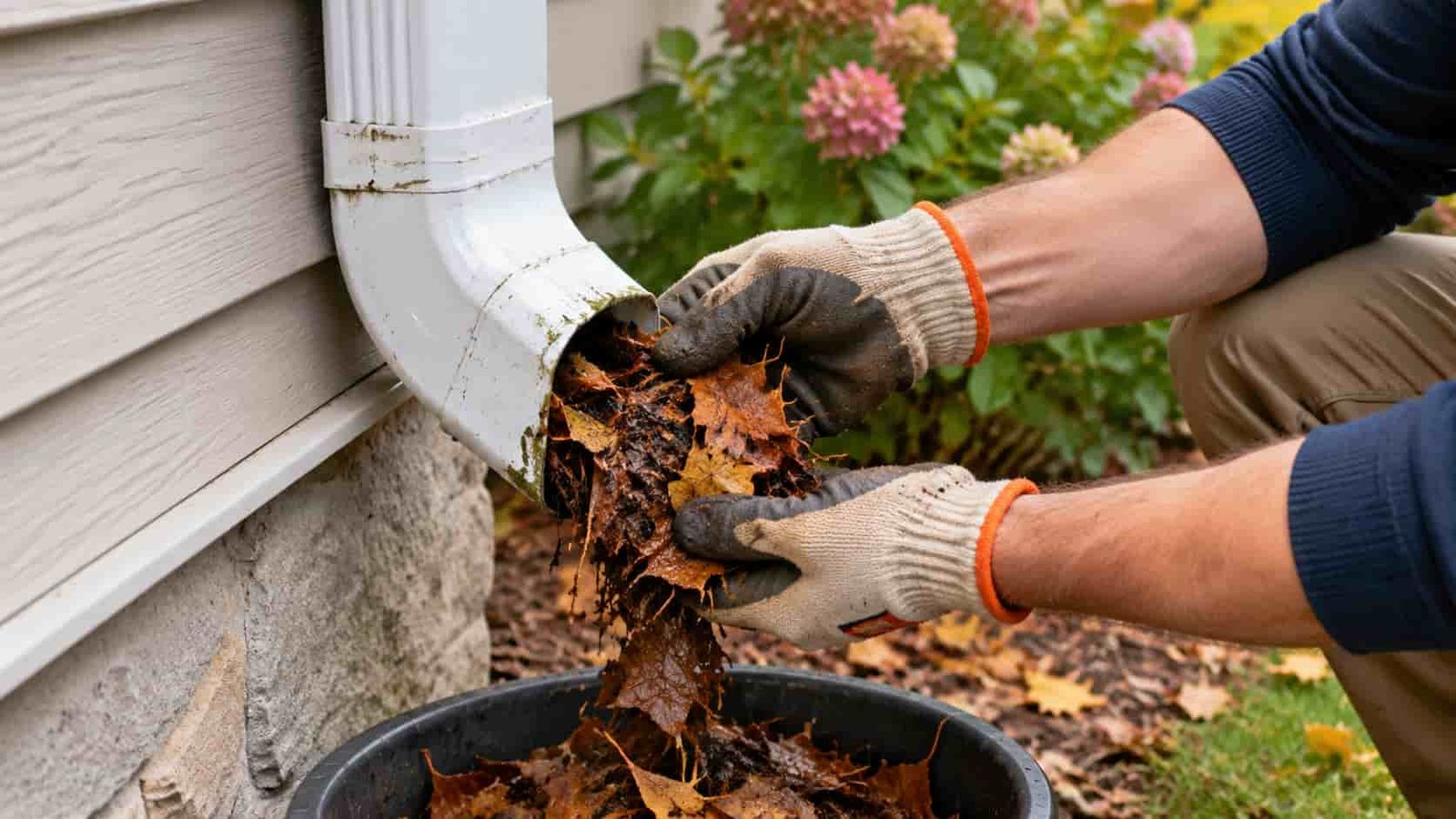
Because a clean gutter still overflows if the downspout is blocked. Water has to leave the system, and the downspout is the exit. Many homeowners clear the channel, see leaves gone and stop, while a clog sits at the bottom of the pipe.
Bob Vila’s guide says clogged downspouts cause overflow and suggests a plumber’s snake to break up a clog, followed by a hose rinse (Bob Vila, 2024). It also advises running water through the gutters and downspouts until both drain freely after clearing debris.
How Do You Check a Downspout?
Run a hose into the gutter from the high end and watch the water leave the downspout. If it slows, backs up or stops, the pipe is blocked.
- Clear the gutter by hand first
- Run water into the outlet and watch the downspout
- If flow is weak, loosen the clog with a plumber’s snake or flush it from the bottom
- Rinse again and check that water leaves freely
- Check that the extension carries water away from the foundation
What About the End of the Downspout?
The downspout must also discharge in the right place. The City of Toronto says it is mandatory for property owners to disconnect downspouts from the City sewer system, and that water should flow away from foundation walls (City of Toronto, 2025). A short downspout dumping water beside the house is a mistake, even if the gutter itself is clean.
Mistake 3: Are You Using the Wrong Tools?
Yes, if you are using bare hands, metal tools or a plain hose. Use heavy-duty gloves, a bucket, and a plastic scoop or trowel. Bob Vila lists gloves, a bucket for debris and a scoop or trowel as basics, and recommends a rigid hose attachment to direct water from the ground (Bob Vila, 2024).
| Tool | Use | Avoid |
|---|---|---|
| Heavy-duty gloves | Protect from sharp edges and debris | Thin or loose gloves |
| Plastic scoop or trowel | Remove debris without scratching | Metal tools that scratch or dent |
| Bucket with hook | Collect debris safely | Dropping debris on the lawn or onto people |
| Hose with rigid wand | Flush the channel from the ground | Plain hose that cannot reach or direct water |
| Safety glasses | Protect eyes from splashes | No eye protection |
Mistake 4: Can Pressure Washing Damage Your Gutters?
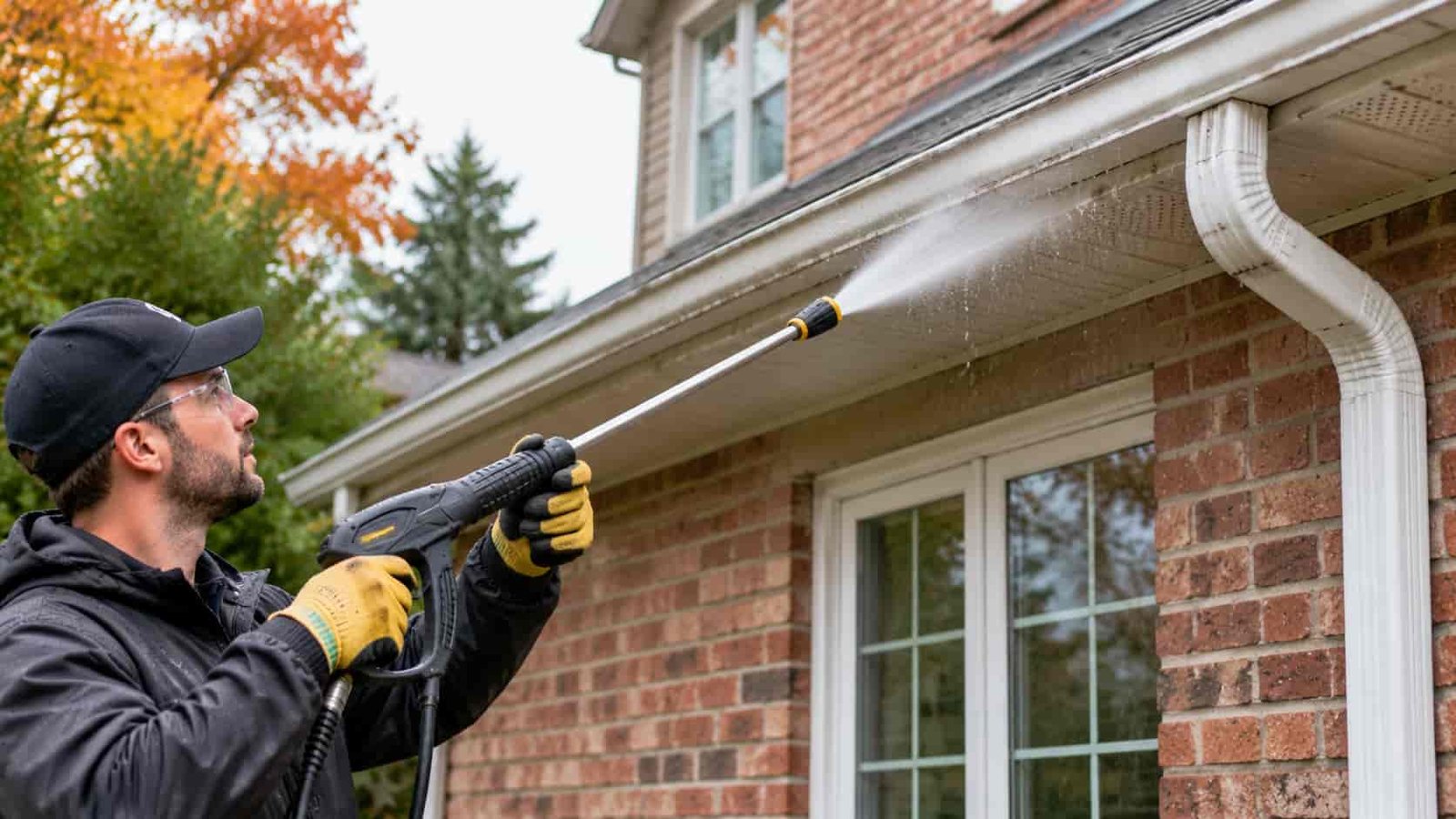
Yes. High pressure can loosen seams, strip sealant, bend thin aluminum and force water behind the gutter and into the fascia. Pressure washing can also leave grime behind, so Bob Vila advises rinsing the roof and exterior walls afterwards (Bob Vila, 2024).
Use low pressure, keep the nozzle moving and do not aim water up under shingles. Remove bulk debris by hand first, so the washer is only polishing, not hammering.
When Is Pressure Washing Appropriate?
For the outside of the gutters, to remove staining, or on very sturdy systems at low pressure. For the inside of the channel, hand removal and a gentle flush work better. Our guide to what is power washing explains where high pressure is the right tool.
Mistake 5: Should You Hose Out Heavily Clogged Gutters?
No, not before removing the bulk of the debris. Bob Vila says the hose method only works if gutters are not thoroughly clogged, and that heavy debris should be removed first by hand or with a vacuum (Bob Vila, 2024). Hosing packed debris turns it into slurry that blocks the outlet.
Mistake 6: Are You Blowing Debris into the Downspout?
This is a classic. A leaf blower pushes debris along the gutter and straight into the downspout, where it jams. Bob Vila advises blocking the downspout with a rag or towel before using a leaf blower (Bob Vila, 2024).
Clear the debris from the channel, remove the plug and then flush the downspout. That sequence keeps the pipe open.
Mistake 7: Why Is Cleaning Too Rarely a Problem?
Gutters that sit full carry extra weight, hold moisture against the roof edge and can freeze. Bob Vila recommends cleaning about once a year, after autumn leaves fall, and warns that clogged gutters can freeze into heavy ice blockages that may pull a gutter away from the roof (Bob Vila, 2024).
In the GTA, freeze-thaw winters make this more likely. Homes under mature trees or near ravines such as the Don Valley, Humber River and Rouge often need cleaning more than once a year.
| Home situation | Suggested frequency (typical estimate) |
|---|---|
| Few trees nearby | Once a year, after leaf fall |
| Mature trees or ravine lot | Twice a year, plus checks after storms |
| Gutter guards installed | Check yearly, clean as needed |
| Before a forecast storm | Quick check of outlets and downspouts |
These frequencies are suggestions and depend on your property. For storm timing, read our guide on how to prepare your gutters for storm season.
Mistake 8: Not Dressing or Planning for the Mess?
Gutter water and debris splash everywhere, so wear clothes you do not mind getting dirty. Bob Vila notes that water, leaves and twigs can splash over the sides while you spray (Bob Vila, 2024). Lay a tarp below, wear gloves and eye protection, and plan where the debris will go.
Mistake 9: Skipping the Final Flush and Check?
Finish every clean with a water test. After removing debris, run water through the gutters and downspouts until both drain freely (Bob Vila, 2024). Look for drips at seams, pooling and sagging sections while the water runs.
This is also the moment to spot damage. If you see leaks, loose brackets or sagging runs, our guide on the signs you need gutter repair explains what to do next.
Can You Damage Gutters by Cleaning Them Wrong?
Yes. Poor technique can bend or scratch the metal, loosen brackets, break sealant or pull sections off the fascia. Most damage comes from three things: weight on the gutter, high-pressure water and metal tools.
- Leaning a ladder against the gutter edge
- Pushing metal tools along thin aluminum
- Pressure washing seams and sealant
- Pulling at stuck debris and tearing hangers
- Walking on gutters or on the roof edge
Small damage is usually repairable. Large sagging or rotted fascia may mean replacement, which our eavestrough cleaning cost in Toronto guide helps you compare against the cost of cleaning.
What Should You Do with the Debris You Remove?
Bag it and put it in your yard waste or compost, not down a storm drain or onto the lawn edge where it washes back. Gutter debris is wet, heavy and often full of seeds that sprout in the channel if left behind.
Check your municipal rules for yard waste collection. In Toronto, leaves and garden waste usually have their own collection stream, but confirm the current rules with the City.
What Should You Check Once the Gutters Are Clean?
Look at the whole system, not just the channel. A clean gutter can still fail if a bracket is loose, a seam is leaking or the slope has changed.
- Sagging or low spots where water pools
- Loose or missing brackets and fasteners
- Rust, cracks or peeling paint at seams
- Stains on the fascia or siding below the gutter
- Downspout brackets and the extension at ground level
Write down what you find and fix small problems before the next storm. That habit turns cleaning into maintenance, not just a chore.
Should You Do It Yourself or Hire a Professional?
Do it yourself if your home is one storey, the gutters are easy to reach and you are confident with ladders. Hire a professional for two storeys or more, steep roofs, heavy clogs or any doubt about safety. Professionals have the equipment, the training and the insurance for the job.
| Situation | Better choice |
|---|---|
| Single-storey, accessible gutters, light debris | DIY with proper ladder and gloves |
| Two storeys or higher | Professional |
| Heavy clogs, plants growing in gutters | Professional |
| Not comfortable on ladders | Professional |
| Signs of damage or rot | Professional inspection |
At Silkwaters Windows & Eaves Cleaning, eavestrough cleaning is one of our main services. Ask any company about insurance and WSIB coverage before they start.
How Much Does Professional Gutter Cleaning Cost in Toronto?
HomeStars lists eavestrough cleaning at $1.00 to $2.50 per linear foot, gutter guards at $7 to $20 per linear foot, downspouts at $100 to $300 each and repairs at $75 to $150 per hour (HomeStars, 2026). The cost of one visit is small compared with repairing water damage.
| Service | Typical cost (HomeStars, 2026) |
|---|---|
| Eavestrough cleaning | $1.00 to $2.50 per linear foot |
| Gutter guards | $7 to $20 per linear foot |
| New gutters | $5 to $15 per linear foot |
| Downspouts | $100 to $300 each |
| Repairs | $75 to $150 per hour |
These are ranges, not quotes, and your price depends on gutter length, height and condition.
What Is a Safe, Simple Gutter Cleaning Routine?
Follow the same order every time: safety first, then debris, then downspouts, then a flush and check. A consistent routine prevents the mistakes above.
- Check the weather and the ladder, and arrange a helper
- Set the ladder at the right angle on firm ground
- Clear debris by hand into a bucket
- Block the downspout if you use a blower, then remove the plug
- Flush the gutters and downspouts and watch the flow
- Check seams, brackets and the downspout extension
- Rinse the exterior if needed, and put tools away
Frequently Asked Questions
What is the biggest gutter cleaning mistake? Unsafe ladder use. Use an extension ladder at the correct angle with three-point contact and a helper (CCOHS, 2023).
Why do my gutters still overflow after cleaning? A downspout may be blocked, the slope may be wrong or the outlet may still be partly clogged.
Can pressure washing damage gutters? Yes. High pressure can loosen seams, strip sealant and force water behind the gutter. Use low pressure and clear debris by hand first.
How often should I clean my gutters? At least once a year, after autumn leaves fall (Bob Vila, 2024). Homes with many trees may need it twice a year.
Is a leaf blower good for gutters? It can be, but block the downspout first so debris does not jam inside it (Bob Vila, 2024).
Should I clean gutters myself on a two-storey home? Bob Vila advises leaving homes over one storey to a gutter cleaning company (Bob Vila, 2024).
How much does gutter cleaning cost in Toronto? HomeStars lists $1.00 to $2.50 per linear foot (HomeStars, 2026).